Ghosting the Negative — Perspective, Insight, and Retreat: Hanged Man (XII), Eye (49), Hexagram 33
Sunday, December 7, 2025

Hello, my friends,
Welcome back to my ongoing exploration of Tarot, the Gypsy Witch Fortune Telling Cards, and the I Ching. Each post offers both an invitation to contemplation and a space to share your own insights. If you feel drawn to this article, perhaps the theme of reflection is resonating with you—or maybe you’re simply curious about how synchronicity reveals itself in everyday life. My Sunday articles look toward the week ahead, so let’s step into them together.
This is my Sunday piece, setting the tone for the entire week. Last week, I made it a practice to track each day and see whether the Sunday spread proved true. What do you think of that approach?
Today’s spread brings together three voices: The Hanged Man (Tarot XII), The Eye (Gypsy Witch, Card 49), and Hexagram 33 from the I Ching.
The Hanged Man (12 Tarot): The Major Arcana card XII–The Hanged Man is a profoundly symbolic card representing sacrifice, stasis, initiation, waiting, focus, independence, and enlightenment, and a change in perspective. It is one of the three “quality cards” used in certain reading methods, where it signifies the quality of being fixed, representing permanence, stability, and focus.
49 The Eye (Gypsy Witch): The eye, when near, denotes great interest taken by friends; when distant, it signifies suspicion. An inset card of Four of Spades, which in cardomanty is traditionally associated with troubles, sickness, and immobilization.
Hexagram 33, Retreat/Withdrawal (I Ching): This hexagram is formed by Heaven above Mountain. It indicates successful progress in its circumstances. In this situation, a little firmness and integrity will still help—but don’t overdo it
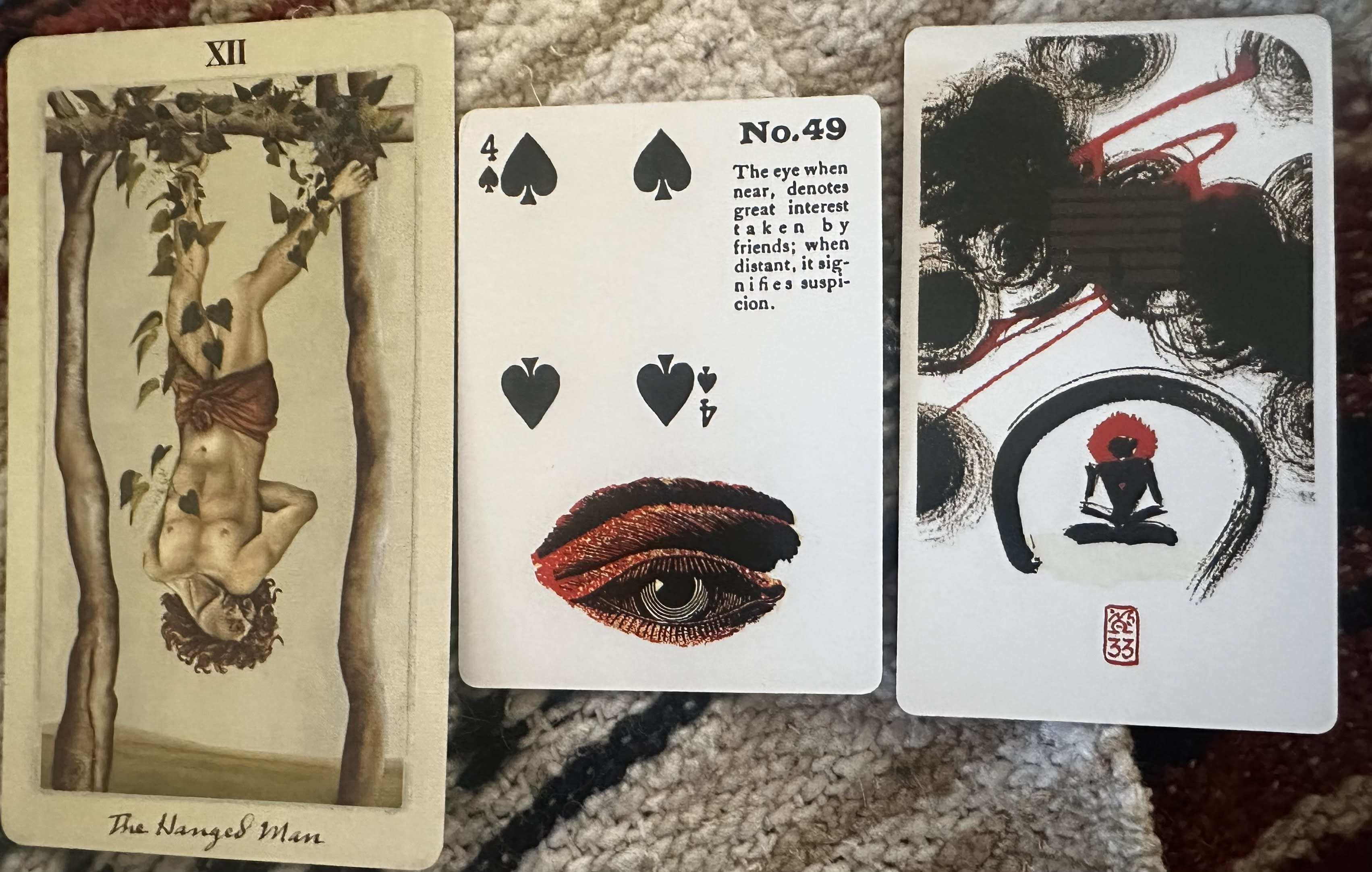
What message are you seeing in the cards today?
The photo above is yours to interpret. What does it evoke for you? Use the comment or chat buttons to share your thoughts—your perspective is part of this space. I believe the reader’s experience is central; instead, I invite you to find your own meaning
For a touch of bibliomancy, today’s guiding line comes from An Introduction to Haiku (p. 34).
“No poem you send,
in answer—Oh, young lady!
Springtime nears its end.”
—Buson
Any synchronicities that are happening around you, maybe one of those will hint at the meaning of these cards.
If this quote doesn’t resonate, feel free to turn to your own trusted sources and see what unfolds.
Here is my card-inspired poem.
From a different view,
Insight into the ugly truth,
Don’t feed the trolls.
If anything stirred or settled in you, I’d be honored to hear. Did the quote or poem spark a memory or insight? If you feel moved to respond, I’m listening.
My Interpretation
Here is how I understand the message of today’s spread: the energy begins with the Hanged Man (Tarot XII), moves into the Eye (Gypsy Witch, Card 49), and finds resolution in the patient unfolding of Hexagram 33: Retreat/Withdrawal (I Ching).
The Hanged Man (Tarot XII)
Last week’s card was Death, and this week we encounter the Hanged Man. Where Death speaks of transformation and endings, the Hanged Man emphasizes suspension and pause. Yet this pause is not empty—it invites us to see the world from a different perspective, to shift our view and recognize meaning in what seems stalled.
This sense of altered vision is what I feel connects directly to the next card. The Hanged Man’s inversion is not about loss, but about reorientation—a reminder that sometimes clarity comes only when we step outside of our usual vantage point.
The Eye (Gypsy Witch 49)
The Eye is such a curious symbol, isn’t it? At first glance, it might seem like a window into the soul, but remembering the era in which these cards were created, the Eye often served as an omen—warning of suspicion, illness, or consequences. Yet in esoteric traditions, the Eye is also the holder of truth, even when that truth carries a warning. Its power lies in perceiving what is hidden.
This message is reinforced by the inset card, the Four of Spades, which traditionally signifies being stuck, mired down, or immobilized. When combined, the Eye and the Four of Spades suggest that the truth revealed may not be easy—it may bring difficulties or even danger.
Perhaps this is where our bibliomancy quote belongs. Buson’s haiku speaks not through individual lines but through its overall meaning: a young woman does not respond to a young man’s poem, even as spring nears its end. In modern terms, she is “ghosting” him. Her silence prevents him from moving on, leaving him stuck, wondering how she perceives him. The Eye, in this sense, reflects the painful clarity of seeing what is hidden—the truth that immobilizes rather than liberates.
Within today’s spread, the Hanged Man is suspended, perceiving the world from a different angle. His altered vision leads to insight, but that insight may be precisely what causes difficulty. The Eye confirms this tension: truth is revealed, but it is not without consequence. The next card will bring resolution to this set.
Retreat / Withdrawal (Hexagram 33)
The final card in this spread is Hexagram 33, which speaks of retreat or withdrawal. I love the structure of this hexagram: Heaven rising above the Mountains, symbolizing the need to create distance and separate from unfavorable circumstances in order to preserve integrity and strength.
In the context of our spread, the Hanged Man perceives a truth that is difficult to accept, and the natural response is retreat. Yet this raises an important question: when is retreat simply avoidance, and when is it a strategic withdrawal?
A conversation I heard today suggested that avoidance still feeds the negative energy of the thing we dislike. That idea has stayed with me. In my own life, I think about online games with friends, where obnoxious players sometimes flood the chat with cruel words. The common advice is: “Don’t feed the trolls.” But I wonder—does refusing to engage count as a healthy retreat, or is it avoidance?
Hexagram 33 reminds us that retreat is not defeat. It is a conscious choice to step back, conserve energy, and wait for a better time. The difference lies in intention: avoidance comes from fear or denial, while strategic retreat comes from strength and discernment. In this spread, the Hanged Man’s altered vision leads to truth, the Eye reveals its difficulty, and Hexagram 33 offers resolution—withdrawal with dignity, preserving inner spirit until the right moment to act arrives.
Summary
I didn’t expect the poem to weave itself into this spread, but it did. In essence, the Hanged Man perceives a truth that unsettles him, and that realization leads to retreat in order to preserve integrity. An unspoken boundary forms between what has been revealed and the emotions stirred by it.
Just as in Buson’s poem, silence becomes its own response—the Hanged Man “ghosts” these situations, stepping back not out of weakness but to conserve strength and discern the next move.
I’d love to hear what message this spread holds for you.
Thank you for joining me today. Whether it’s the cards, the poem, or whatever resonates most deeply, I’m grateful to share this space with you.
See you tomorrow.
JenX